While I was pretty thorough reading my mortgage documents before signing them I must admit that there was one part that I just skimmed. You see I figured that the skip-a-payment option offered by my bank didn't apply to me. After all when a girl's planning on paying off her mortgage in 5 years she hardly wants to take a "payment vacation." (Have you ever noticed that the statement saying that interest continues grow on your unpaid portion is found at the very bottom in a font that would make a fly want to wear glasses? Gee, wonder why that is!)
Recently though I decided to take a closer look at that part. Turns out that while the normal skip option is available once every 12 months there is a deluxe option for those of us who have doubled our payments. While I've not discussed this with my bank (not needing to use the option) from what I read it works like this; for every extra dollar you've paid they'll let you skip a dollar in payments.
If I am interpreting this correctly I could walk up to the bank tomorrow and ask for an extended payment vacation and not make another payment for over 2 and a half years ($20,631.58 extra paid divided by $646.62 per month = 31.9 months.) Granted I would lose all the headway that I had made paying my mortgage off early and would have to sit there watching the interest slowly grow on the balance (which for me would be excruciatingly painful) but the important thing is that the bank would not foreclose on my house during this time.
Let me be clear, this is NOT my first safety net. I have insurance coverage should I not be able to work, I have very marketable skills should I lose my job, and I have both emergency and personal savings that could keep me afloat (including mortgage payments) for 3 months to 3 years respectively.
What this safety net does provide is a means to hold onto my house for as long as it would take to sell and make other living arrangements should my life fall apart and my other safety nets become unreliable. This option is obviously not as ideal as owning my own place outright it simply adds another layer of security, and that is always worth having.

The personal finance blog of a finance enthusiast. Infused with practical tips, personal stories, and a healthy dose of humour.
Showing posts with label Emergency. Show all posts
Showing posts with label Emergency. Show all posts
Wednesday, 24 July 2013

Wednesday, 26 June 2013
Bad Scenario Game
I like to play something that I call the bad scenario game. The idea is to imagine a scenario that you could plausibly find yourself in that would cause you some level of hardship and create a theoretical plan for how to deal with it. For example:
Say tomorrow I lost my job. What would I do in the short term (next couple of days), medium term (months) and long term.
Short Term
- Immediately go to the bank and return my monthly mortgage payment to it's normal amount (I currently pay and extra 10% each month to pay it off faster)
- Take stock of everything I have laying around in various savings accounts
- Collect my last pay check and make sure that it will cover two months worth of expenses (which is pretty easy when you live of 50% of your income)
- Contact my disability insurance company and let them know that I lost my job (which means in two months time I would be able to start collecting disability benefits to the tune of $3,535.50 a month gross)
- Update resume
Medium Term
- Begin Master's program as planned
- Use disability payments to save the amount that would be required to support me between the end of November 2014 (when my disability payments run out) and April 2015 (when I would be finished my Master's degree
- Look for work as a Teachers Assistant and/or Research Assistant with my University
- Depending on my success for finding a TA/RA role, scope out possible RN jobs in the community that I would be physically able to handle
- Build portfolio of skills that would increase employability, which would likely include becoming involved in a number of different research and teaching areas
Long Term
-Use Veteran's Affairs assistance and my priority hiring status to find a stable long term (physically undemanding) job
- Job search would likely extend beyond provincial borders, so I would prepare to transfer my qualifications from my current college to another one
The short and long of it is that there are a lot of things that I could do in the short and long term to recover from the crises. Some of these steps I have taken in the past when facing job lose some are unique to my current situation.
The point of the Bad Scenario Game is not to freak you out at all the things that could possibly go wrong in your life time. The point of the game is to prove to yourself that even when the worst happens (yes, bad things are going to happen in all of our lives) you have the capability of getting through it and being happy during the process.
Say tomorrow I lost my job. What would I do in the short term (next couple of days), medium term (months) and long term.
Short Term
- Immediately go to the bank and return my monthly mortgage payment to it's normal amount (I currently pay and extra 10% each month to pay it off faster)
- Take stock of everything I have laying around in various savings accounts
- Collect my last pay check and make sure that it will cover two months worth of expenses (which is pretty easy when you live of 50% of your income)
- Contact my disability insurance company and let them know that I lost my job (which means in two months time I would be able to start collecting disability benefits to the tune of $3,535.50 a month gross)
- Update resume
Medium Term
- Begin Master's program as planned
- Use disability payments to save the amount that would be required to support me between the end of November 2014 (when my disability payments run out) and April 2015 (when I would be finished my Master's degree
- Look for work as a Teachers Assistant and/or Research Assistant with my University
- Depending on my success for finding a TA/RA role, scope out possible RN jobs in the community that I would be physically able to handle
- Build portfolio of skills that would increase employability, which would likely include becoming involved in a number of different research and teaching areas
Long Term
-Use Veteran's Affairs assistance and my priority hiring status to find a stable long term (physically undemanding) job
- Job search would likely extend beyond provincial borders, so I would prepare to transfer my qualifications from my current college to another one
The short and long of it is that there are a lot of things that I could do in the short and long term to recover from the crises. Some of these steps I have taken in the past when facing job lose some are unique to my current situation.
The point of the Bad Scenario Game is not to freak you out at all the things that could possibly go wrong in your life time. The point of the game is to prove to yourself that even when the worst happens (yes, bad things are going to happen in all of our lives) you have the capability of getting through it and being happy during the process.
Tuesday, 29 January 2013
My Philosophy on Emergencies
Over the last week I have taken you through some simple
steps that will help you be prepared in the case of an emergency. Making sure that you are prepared for a
disaster helps to minimize the damage to both your wallet and your life.
I distinctly remember during my last year of nursing two
back-to-back lectures. One was for
my complex care class and the other was for my community health class. Both of them were on the role of a
nurse during a natural or man made disaster. After 6 hours I walked away with one message; be afraid, be
very afraid.
Fortunately I had the chance to muse over what I was told
and eventually decided to take a somewhat pragmatic view of the matter. Yes, there is the chance, even the
likelihood, that disaster will strike within your lifetime. On the bright side there are many
things that you can do to prepare for and mitigate the outcome of a
disaster. The question is how much
is enough?
When allowed to our imagination will run wild with all the
awful things that could possibly happen and soon it will seem that you are only
safe if you have a million dollar emergency fund and a nuclear bomb shelter in
the basement. I can’t give you
exact number to keep in the bank though I’ll ball park the normal 3-6 months of
living expenses. I also can’t tell
you if you should stop at a panic bag or go further. My advice is do what you need to do to sleep at night.
With that in mind remember the following. You need never face a disaster
alone. When you lose your job or
your house burns down your family and friends will be there. Maybe not with an open checkbook but
with help in your job hunt or a warm bed for the night. Some of the most devastating natural
and man made disasters in history have also resulted in the most generous and
amazing shows of human compassion and aid. While friends, family, and community will not remove the
need for a good emergency fund and an emergency plan; neither will an emergency
fund or an emergency remove the need for friends, family, and community. How can you be sure that people will be
there in your time of need? By
being there for them in their time of need.
Monday, 28 January 2013
Panic Bag - Part 2
If you don't know what a panic bag is or if you want to know how to start one please read yesterday's post, aptly entitled Panic Bag - Part 1.
Today we will continue with the miscellaneous items that should find their way into a panic bag.

2) Money. Personally I recommend cash in small bills. I have enough in my bag to buy myself a one way ticket to my parent's home (they are my closest relatives). I have heard the recommendation of keeping an unused credit card in the bag. This does have the advantage of giving you access to more money then I would be comfortable with laying around in cash. I do however have 2 problems with this idea. People who haven't got the discipline not to touch it may use it for "emergencies" that it is not intended for. In a natural disaster or similar wide spread disaster there may be problems with power outages and such making a credit card useless. If you do want to keep a credit card in your panic bag I would also recommend some cash as well. I've never met any one who turns down cash.
3) Soap, tooth brush, and tooth paste. Pretty self explanatory. To keep costs down I used a toothbrush that is almost ready for the garbage and toothpaste that has maybe a weeks worth left. Travel sized toothpaste/toothbrush is also an option.
4) Feminine hygiene products. If you need to ask go ask your parents please.
5) Paperwork. I have a list of the names, addresses, and phone numbers of all my close relatives. At least keep a list of phone numbers, if you lose your cell you don't want to have to try and remember all the important numbers. This also has a photo copy of all the important documents in my wallet. Health card (government and Veterans Affairs), drives license, bank card and credit card, bus pass, and insurance card. This also serves the dual purpose of giving me a list of numbers in case my wallet is stolen or lost and I need to start cancelling cards.
6) Key and flashlight. I keep my spare house key in the bag (if you have a car you should keep a spare in here as well). The key chain is actually a small flash light who's batteries can be recharged with a wind up key on the side.
7) A map of the local area. Yes, guys should probably have one packed too.
8) Medications, glasses, hearing aids, etc. I don't have any necessary medications so there are none in the picture. However, if you do have a medical condition make sure that you have a week supply of your medications and/or medical supplies
That is the whole content of my panic bag. These bags are highly individual, however I believe that my bag is fairly typical. There should be one for each member of the family; some people also prefer to keep more than one bag, ie one at home, one at the office or in the car. Most resources also recommend that the bags be labeled so each family member can find their own. (Though if the house is burning down I would expect you are going to help grab all of the bags not just your own.)
Is there anything not on my list that you would add to your panic bag?
Today we will continue with the miscellaneous items that should find their way into a panic bag.

1) Water bottle and snacks. Obviously you're going to chose snack that will last a while in your bag (no a banana probably isn't a good idea, even if it has potassium). I went with protein bars. I would suggest staying away from high sugar snacks, they may give you an initial rush, but you will crash and burn just as quickly. If you don't want to keep a full bottle of water in your bag I would recommend an empty bottle that can be filled up.
2) Money. Personally I recommend cash in small bills. I have enough in my bag to buy myself a one way ticket to my parent's home (they are my closest relatives). I have heard the recommendation of keeping an unused credit card in the bag. This does have the advantage of giving you access to more money then I would be comfortable with laying around in cash. I do however have 2 problems with this idea. People who haven't got the discipline not to touch it may use it for "emergencies" that it is not intended for. In a natural disaster or similar wide spread disaster there may be problems with power outages and such making a credit card useless. If you do want to keep a credit card in your panic bag I would also recommend some cash as well. I've never met any one who turns down cash.
3) Soap, tooth brush, and tooth paste. Pretty self explanatory. To keep costs down I used a toothbrush that is almost ready for the garbage and toothpaste that has maybe a weeks worth left. Travel sized toothpaste/toothbrush is also an option.
4) Feminine hygiene products. If you need to ask go ask your parents please.
5) Paperwork. I have a list of the names, addresses, and phone numbers of all my close relatives. At least keep a list of phone numbers, if you lose your cell you don't want to have to try and remember all the important numbers. This also has a photo copy of all the important documents in my wallet. Health card (government and Veterans Affairs), drives license, bank card and credit card, bus pass, and insurance card. This also serves the dual purpose of giving me a list of numbers in case my wallet is stolen or lost and I need to start cancelling cards.
6) Key and flashlight. I keep my spare house key in the bag (if you have a car you should keep a spare in here as well). The key chain is actually a small flash light who's batteries can be recharged with a wind up key on the side.
7) A map of the local area. Yes, guys should probably have one packed too.
8) Medications, glasses, hearing aids, etc. I don't have any necessary medications so there are none in the picture. However, if you do have a medical condition make sure that you have a week supply of your medications and/or medical supplies
That is the whole content of my panic bag. These bags are highly individual, however I believe that my bag is fairly typical. There should be one for each member of the family; some people also prefer to keep more than one bag, ie one at home, one at the office or in the car. Most resources also recommend that the bags be labeled so each family member can find their own. (Though if the house is burning down I would expect you are going to help grab all of the bags not just your own.)
Is there anything not on my list that you would add to your panic bag?
Sunday, 27 January 2013
Panic Bag - Part 1
I have dedicated much of the past week to emergency preparedness. Something that most people don't start thinking about until it's too late.

I'd wager most people don't know what a panic bag (or a go bag) is. Basically it is a pre packed bag of essentials that you grab and run with in a bad situation. For example, your house is burning down, there is a natural disaster in the area and you need to evacuate, the mafia is after you, or the planet is being invaded by aliens. (Ok a panic bag probably wouldn't help with alien invasion, but not much would soooooooooooo . . . we'll leave that out of the planning process.)
Panic bags are highly individual, but basically they should help to sustain you until help can arrive, or you can get out of the area. Make sure you keep it in an accessible place, preferable near the exit that you are most likely to take, mine is in my front closet. I'll take you through my process of putting together my bag with the whys of the items so that you can decide what would best fit into your bag.

1) The bag. I use an old book bag that I had in the house. It's worn but still functional. Make sure the bag is big enough to carry everything you'll need but don't get carried away. If you end up having to carry it a distance you won't want it to be too large or awkward to carry.
2) Under clothes. One change. Do I really have to explain this? I didn't think so.
3) Pants and shirt. I've packed stuff that I don't wear and won't miss. Here you have options. You can either repack with the seasons or pack something that should be acceptable in a variety of climates. I choose the second. That way I don't have to remember and will be prepared for unseasonably warm/cold weather.
4) Shoes. I chose old runners that I had laying around. They are still serviceable but were retired after a couple seasons of cross country.
5) Outer wear. I struggled a bit with this choice. I didn't have an old coat hanging around and didn't want to buy a new one just to see it sitting around in my panic bag. I went with a sweater that I don't wear and my old military wind breaker. I can layer them in most cold weather to be adequately warm. Since I keep the bag in my front hall closet with my winter coat I should be able to grab my heavy duty coat (without losing time) if the weather is sever. (Technically I'm not to suppose to wear my old military wind breaker with civilian clothes, but if my house just burnt down I pity the poor soul who comments on it.)
6) Touque and mits. Optional in some countries, but not if you live in the true north strong and free and cold and wet and icy. . .
Every thing is wrapped in plastic milk bags to help keep them dry, any one who's camped knows this trick.
That wraps up clothes for the panic bag, tune in tomorrow for part 2!
Wednesday, 23 January 2013
Getting where you need to go
For those of you who are new, I live in Canada. It has many charms including it's natural beauty. Its vast natural beauty. Canada is the second largest country in the world and in certain areas is sparsely populated. Unfortunately this can make emergency planning a bit more difficult when it comes to seeing to your transportation needs.
When I had a vehicle I had a rule, the gas tank always had to be at least half full. This covered 2 possible emergency situations that I may have faced. First off it was enough gas to get me and my sister where we needed to be for at least 2 weeks in the event of a fuel shortage. If it looked like the shortage was going to last for a while we probably could have made it last a month or longer since we lived right down town. Secondly, it was enough gas to get us to our closest relatives in case the area had to be evacuated or if our apartment burnt down.
Currently I depend on public transit to get to work and could handle a hike in price if there was a fuel shortage, in a pinch I could work from home 75% of the time. If I needed to get out of the area due to natural disaster or because my house burnt down I have my panic bag. A panic bag is also commonly referred to as a go bag. I will talk about it in detail in another post, but the general idea is that it is a pre-packed bag of essentials that you grab if you need to get out of your house/area quickly. To cover transportation I have enough cash in my panic bag to buy myself a train ticket to my parent's house (who are currently my closest relatives).
The arrangements that you make for emergency transportation are highly individual. I would suggest that you make sure you can answer the following questions comfortable:
-If there is a sudden fuel shortage how will you get to the places you need to be for the next 2 weeks? The next month?
-If you lose your house can you get yourself and family to a safe place to stay that you will be able to afford (friend's or family's house perhaps) in the light of the emergency?
-In the case of a natural disaster could you get yourself an appropriate distance away?
When I had a vehicle I had a rule, the gas tank always had to be at least half full. This covered 2 possible emergency situations that I may have faced. First off it was enough gas to get me and my sister where we needed to be for at least 2 weeks in the event of a fuel shortage. If it looked like the shortage was going to last for a while we probably could have made it last a month or longer since we lived right down town. Secondly, it was enough gas to get us to our closest relatives in case the area had to be evacuated or if our apartment burnt down.
Currently I depend on public transit to get to work and could handle a hike in price if there was a fuel shortage, in a pinch I could work from home 75% of the time. If I needed to get out of the area due to natural disaster or because my house burnt down I have my panic bag. A panic bag is also commonly referred to as a go bag. I will talk about it in detail in another post, but the general idea is that it is a pre-packed bag of essentials that you grab if you need to get out of your house/area quickly. To cover transportation I have enough cash in my panic bag to buy myself a train ticket to my parent's house (who are currently my closest relatives).
The arrangements that you make for emergency transportation are highly individual. I would suggest that you make sure you can answer the following questions comfortable:
-If there is a sudden fuel shortage how will you get to the places you need to be for the next 2 weeks? The next month?
-If you lose your house can you get yourself and family to a safe place to stay that you will be able to afford (friend's or family's house perhaps) in the light of the emergency?
-In the case of a natural disaster could you get yourself an appropriate distance away?
Tuesday, 22 January 2013
Emergencies and Insurance
Most of the blogs that I have read talk about insurance of some type at some point. Life, health, disability, house, car . . . the list goes on. In the spirit of Emergency preparedness let me speak to you of one of the cheapest forms of insurance I have ever found. You want to know what the great thing is? It covers life, health, disability and house in one fell swoop. This insurance has two parts. Part 1 is $20 flat rate and a yearly cost of maybe $5. Part 2 is a $50 flat rate, no maintenance required. Part 2 can even be used to cover your car! Is that great or what?
Ok, so where do I get such a great deal? Try your local hard ware store.
I'm sorry . . . what? Oh you were under the impression that this was typical insurance. You know, the kind that pays after your house burns down, or you have medical bills, or you're dead. No, this is much better, this is the kind that helps to prevent any of that from ever happening.
Meet Plan 1

His name is Clive, his brother Jobb lives upstairs. (Ok, so I named the smoke detectors, why not show a little appreciation to them?) I have always considered myself a stickler for fire safety. In fact during my four years in apartment buildings (always on the 11th or higher floor, a couple of which had faulty fire alarms) I was always one of the 5% who evacuated the building.
So when I bought my first home the first thing I did was check out the smoke alarms. The one downstairs had been removed (not sure how long ago) and I promptly replaced it. Up stairs was a different story. There were two of them side by side. Unfortunately the one that was suppose to be hard wired into the house had been hung but not connected. Not a big deal, I figured that they had hung a stand alone unit next to it because it was the cheaper (and no less safe) solution. The stand alone unit looked fine, until I found out that no one had ever bothered to put batteries in it.
I was shocked. Honestly? We spend hundreds of dollars on house insurance and we can't be bothered to put batteries in our smoke detectors? Do you want the insurance company to have to pay up? Worse, the family who sold me the smoke detector-less house had 4 kids.
Check Your Smoke Detectors People.
Every. Six. Months.
If you're lucky they won't have to save your life.
Meet Plan 2

I'd love to say that I am impeccably safe in all things. That would be a lie. Truth is I knew that I needed a fire extinguisher for my kitchen. I knew that fact for almost three years. But going out to buy one . . .
Why I'd have to go into a store! YEWWWWWWW
I'd have to pay money! GASP
It got put off, and off and off. I'd forget it for months on end, then it would end up on my to-do list and just never get done. What changed? There was a fire in the apartment building next door. As in glass-popping-due-to-heat, flames-shooting-out-the-windows fire. As in damage two floors down and five stories up, the whole apartment had to be gutted fire. This made me realize two things.
1. No matter how careful I am accidents will happen, I need to do my best to make sure that they don't turn into major incidents.
2. No matter how careful I am other people will happen. I can't guarantee that somebody who lives around me isn't going to do something that will endanger me and mine.
Protect your life, protect your possessions, and save the money I would cost you if your house burned down.
PS. I'm still thinking of a name for the fire extinguisher. Alfred has a nice ring to it. Suggestions?
Ok, so where do I get such a great deal? Try your local hard ware store.
I'm sorry . . . what? Oh you were under the impression that this was typical insurance. You know, the kind that pays after your house burns down, or you have medical bills, or you're dead. No, this is much better, this is the kind that helps to prevent any of that from ever happening.
Meet Plan 1

His name is Clive, his brother Jobb lives upstairs. (Ok, so I named the smoke detectors, why not show a little appreciation to them?) I have always considered myself a stickler for fire safety. In fact during my four years in apartment buildings (always on the 11th or higher floor, a couple of which had faulty fire alarms) I was always one of the 5% who evacuated the building.
So when I bought my first home the first thing I did was check out the smoke alarms. The one downstairs had been removed (not sure how long ago) and I promptly replaced it. Up stairs was a different story. There were two of them side by side. Unfortunately the one that was suppose to be hard wired into the house had been hung but not connected. Not a big deal, I figured that they had hung a stand alone unit next to it because it was the cheaper (and no less safe) solution. The stand alone unit looked fine, until I found out that no one had ever bothered to put batteries in it.
I was shocked. Honestly? We spend hundreds of dollars on house insurance and we can't be bothered to put batteries in our smoke detectors? Do you want the insurance company to have to pay up? Worse, the family who sold me the smoke detector-less house had 4 kids.
Check Your Smoke Detectors People.
Every. Six. Months.
If you're lucky they won't have to save your life.
Meet Plan 2
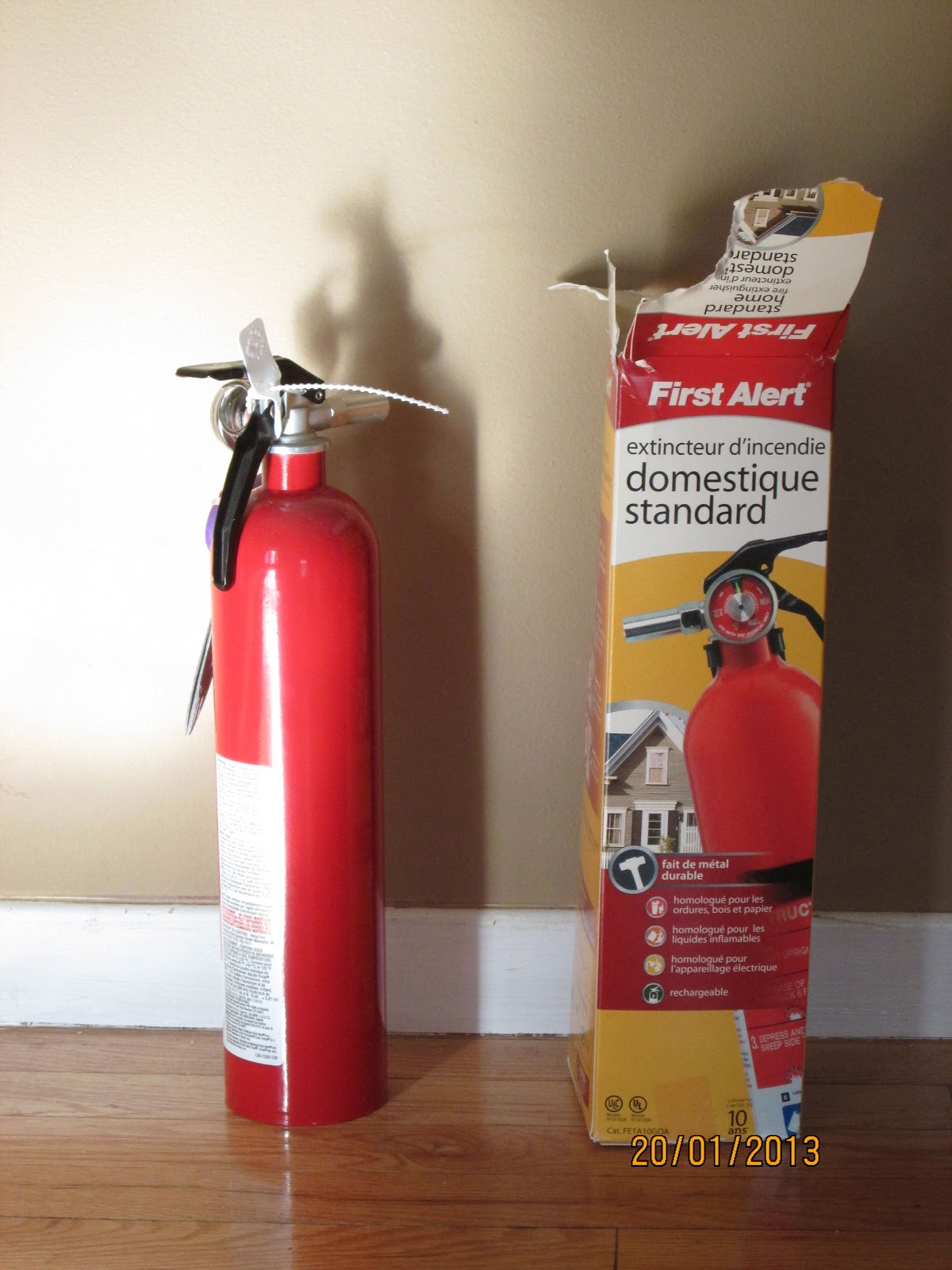
I'd love to say that I am impeccably safe in all things. That would be a lie. Truth is I knew that I needed a fire extinguisher for my kitchen. I knew that fact for almost three years. But going out to buy one . . .
Why I'd have to go into a store! YEWWWWWWW
I'd have to pay money! GASP
It got put off, and off and off. I'd forget it for months on end, then it would end up on my to-do list and just never get done. What changed? There was a fire in the apartment building next door. As in glass-popping-due-to-heat, flames-shooting-out-the-windows fire. As in damage two floors down and five stories up, the whole apartment had to be gutted fire. This made me realize two things.
1. No matter how careful I am accidents will happen, I need to do my best to make sure that they don't turn into major incidents.
2. No matter how careful I am other people will happen. I can't guarantee that somebody who lives around me isn't going to do something that will endanger me and mine.
Protect your life, protect your possessions, and save the money I would cost you if your house burned down.
PS. I'm still thinking of a name for the fire extinguisher. Alfred has a nice ring to it. Suggestions?
Monday, 21 January 2013
Emergencies - The Financial
At the moment there are three fire trucks and one ambulance on my street. Just a couple doors down something has obviously gone wrong. It's kind of funny, we all know that such things happen but we all seem certain that it will happen to some one else. Unfortunately we are all "somebody else" to the rest of the world. So begins a series of posts that will leave you a bit less scared by emergencies and a whole lot more prepared.
I'm sure you've all heard of an Emergency Fund. It is a pot of money reserved to tide you through absolute emergencies. (Like losing your job or your furnace cutting out in the middle of winter, not that great sale down at the sporting good store or not having a matching purse for your new favourite shoes.)
The general rule of thumb is to have at least 3 months worth of required living expenses. I would recommend 6 months eventually, especially if you are in a profession where it will take a while to find a job. EVERYONE should have an emergency fund for the following reasons:
1. Bad things happen to good people.
I'm sure that the people down the street are perfectly lovely, they've still got emergency vehicles outside their house.
2. Bad things happen in threes.
Ok, maybe not in threes precisely, none-the-less when one thing goes wrong there is an uncanny trend of all hell breaking lose. Make sure that you have the financial means to take care of multiple disasters.
3. Emergencies are expensive.
What can I say? Most emergencies will come with a large price tag.
4. The other option is credit
Some people will justify a spare credit card or a line of credit as an Emergency Fund. I disagree completely. When disaster strikes and you start calling on credit you are adding financial strain to the situation. In fact when the disaster is finished you will likely find your self in a larger world of hurt since you have dug yourself a hole of debt.
So, where do I stand for my emergency savings? I have a grand total of $480.43 in my savings account. (Give me a bit of a break while I explain to you the why's and what for's). The biggest emergency for me right now would be anything that would cause me to lose my job. Fortunately for the next 2 years I am covered by disability insurance. Any decrease in pay will result in an increase to my disability check which, if necessary, will cover my entire pay check. I have my savings planned so that at the end of 2 years I will $5,743.11 set aside, which is three months of essential living expenses. I don't need much more since I could easily find part time nursing work that my knee could handle.
The second largest emergency I could face would be a problem with my house, for that I have over $4,000 dollars set aside for house maintenance, and more is being set aside each month. In the case of smaller emergencies I have $1,705.32 every month that could be reassigned at a moments notice without skipping bill payments or cutting essentials like food and health care.
I know what could go wrong and I have a plan in place that will allow me to deal with the major problems in life. That gives me control of my life even when things go wrong. There is no reason why you shouldn't put such plans in place too.
I'm sure you've all heard of an Emergency Fund. It is a pot of money reserved to tide you through absolute emergencies. (Like losing your job or your furnace cutting out in the middle of winter, not that great sale down at the sporting good store or not having a matching purse for your new favourite shoes.)
The general rule of thumb is to have at least 3 months worth of required living expenses. I would recommend 6 months eventually, especially if you are in a profession where it will take a while to find a job. EVERYONE should have an emergency fund for the following reasons:
1. Bad things happen to good people.
I'm sure that the people down the street are perfectly lovely, they've still got emergency vehicles outside their house.
2. Bad things happen in threes.
Ok, maybe not in threes precisely, none-the-less when one thing goes wrong there is an uncanny trend of all hell breaking lose. Make sure that you have the financial means to take care of multiple disasters.
3. Emergencies are expensive.
What can I say? Most emergencies will come with a large price tag.
4. The other option is credit
Some people will justify a spare credit card or a line of credit as an Emergency Fund. I disagree completely. When disaster strikes and you start calling on credit you are adding financial strain to the situation. In fact when the disaster is finished you will likely find your self in a larger world of hurt since you have dug yourself a hole of debt.
So, where do I stand for my emergency savings? I have a grand total of $480.43 in my savings account. (Give me a bit of a break while I explain to you the why's and what for's). The biggest emergency for me right now would be anything that would cause me to lose my job. Fortunately for the next 2 years I am covered by disability insurance. Any decrease in pay will result in an increase to my disability check which, if necessary, will cover my entire pay check. I have my savings planned so that at the end of 2 years I will $5,743.11 set aside, which is three months of essential living expenses. I don't need much more since I could easily find part time nursing work that my knee could handle.
The second largest emergency I could face would be a problem with my house, for that I have over $4,000 dollars set aside for house maintenance, and more is being set aside each month. In the case of smaller emergencies I have $1,705.32 every month that could be reassigned at a moments notice without skipping bill payments or cutting essentials like food and health care.
I know what could go wrong and I have a plan in place that will allow me to deal with the major problems in life. That gives me control of my life even when things go wrong. There is no reason why you shouldn't put such plans in place too.
Subscribe to:
Posts (Atom)